

The Claude 4.6 Trap: Why Anthropic’s AI is a Great Brainstormer but a Terrible Manager
Claude 4.6 is a genius.
There, I said it. With its massive 1-million-token context window and its shiny new ability to peek into your Google Calendar and Gmail, Anthropic has built something truly remarkable. It can read your entire project history, analyze your tone, and tell you exactly why you’re procrastinating on that marketing deck.
But here is the truth that’s going to save you a lot of wasted time: Claude is a trap.
It’s the most sophisticated "brainstormer" on the planet. But as a project manager? It’s a total disaster. If you’re looking for a goal tracking app or an ai productivity tool to actually cross the finish line, relying solely on a chat interface is like hiring a world-class philosopher to help you move furniture. They’ll have great insights into the physics of the couch, but you’re still the one doing the heavy lifting.
The Context Window Illusion
Let’s talk about that 1-million-token context window. For the uninitiated, that means Claude 4.6 can "hold" about 750,000 words in its active memory. That’s several novels' worth of data. You can feed it your entire business plan, three years of email threads, and your detailed action plan template.
It’s impressive. It feels like magic.
But "remembering" isn't the same as "executing." Just because Claude knows everything you’ve ever said doesn't mean it’s going to make sure you do what you said you’d do. This is where most Goalbadgers get stuck. They spend three hours chatting with Claude, refining a perfect strategy, and then... nothing happens.
The chat ends. The window closes. The brilliance is archived.
You’re left with a transcript, not a result.
The Librarian vs. The Manager
The best way to understand the Claude 4.6 trap is the "Librarian vs. Manager" analogy.
Claude 4.6 is the world’s best Librarian. Thanks to its new Google Workspace integration, you can ask it, "When am I free next Tuesday for a deep-work session?" It will scan your calendar and give you a perfect answer. It can summarize your 50-item to-do list and categorize it by priority. It’s a passive expert. It waits for you to ask.
A Manager, however, is proactive.
A real goal planner doesn't just tell you that you're busy; it protects your time. When a meeting runs over on a Tuesday, Goalbadger doesn't just watch it happen. It proactively blocks out new time for your deep work. It moves your tasks when your schedule changes. It nudges you when you’re drifting.
Claude is a consultant you pay by the word. Goalbadger is the project manager who stays until the job is done.
If you want to see how a real execution engine works compared to a simple chat bot, check out how it works.
The ADHD Executive Function Gap
For many of us, especially those looking for a productivity app for ADHD, the "blank box" of Claude 4.6 is a dangerous invitation to distraction.
When you open a chat interface, you are in charge. You have to decide what to ask. You have to remember the context. You have to maintain the momentum. For someone struggling with executive function, that blank input field is a nightmare. It’s an open-ended vacuum that sucks up your mental energy before you’ve even started working.
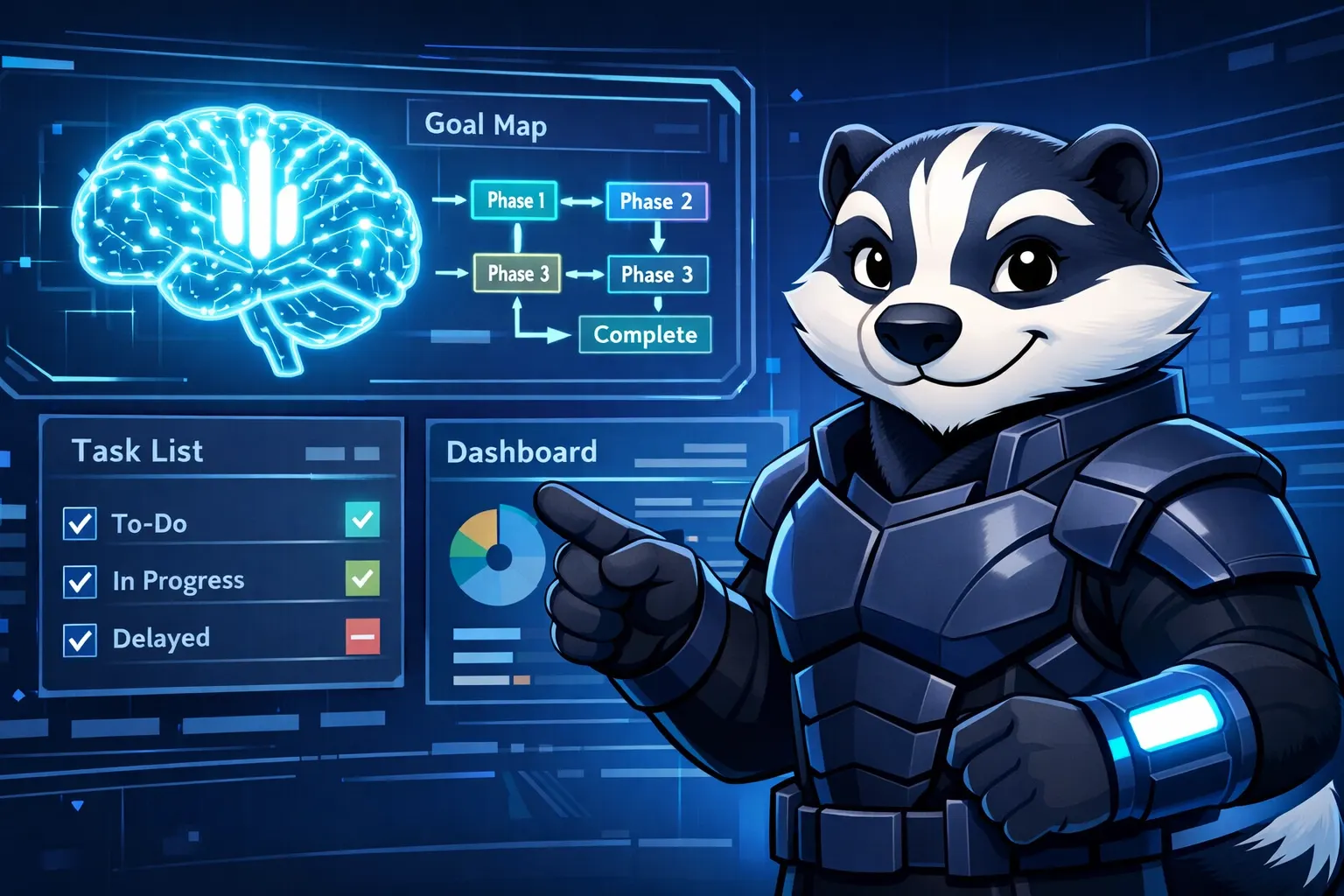
This is why we focus on Visual Goal Maps.

A goal planning app shouldn't be a conversation; it should be a map. You don’t need to ask a map what the next step is, you just look at it. Goalbadger turns those vague "chat vibes" into a persistent, visual structure. You see the Gantt chart, you see the Kanban board, and you see the dependencies.
Claude gives you a list. Goalbadger gives you a landscape.
When your brain hits a wall, you don't need a more eloquent AI to talk to. You need a visual reminder of why you started and exactly where to put your foot next. That’s the difference between a "chat" and a strategy. We’ve written more about this in the problem isn't motivation, it's memory.
The High Cost of "Just Thinking"
Let’s talk numbers. Because in 2026, AI isn't cheap.
Claude Pro costs you $20 a month. That’s fine for basic brainstorming. But if you want to really push that 1M token window and use the "Opus 4.6" powerhouse for complex reasoning, you’re looking at the "Max" tiers. These can run anywhere from $100 to $200 a month.
Two hundred dollars. Just to have a smarter person to talk to.
Contrast that with Goalbadger. For a similar (or often much lower) investment, you aren't just getting an "AI brain." You’re getting:
The AI Brainstormer: Yes, we use high-level models to help you generate your action plan template.
The Infrastructure: Gantt charts, Kanban boards, and automated scheduling that actually talks to your calendar.
The Accountability: Our "Clans" and accountability circles.
The Nudges: Automated follow-ups that don’t wait for you to open an app.
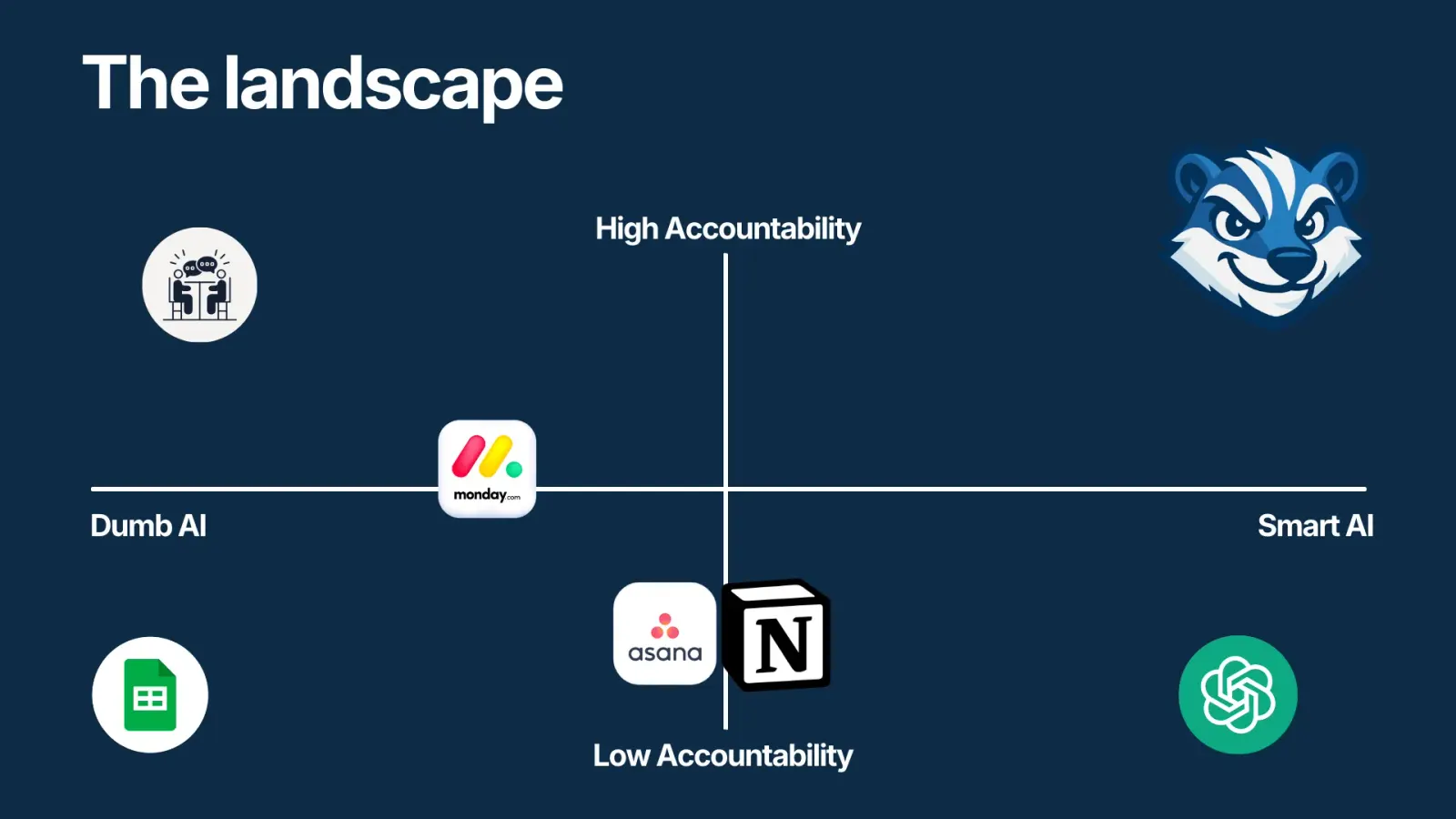
As you can see in the matrix above, most LLMs sits high on the "Intelligence" axis but low on the "Accountability" axis. It’s smart, but it doesn't care if you fail. Goalbadger lives in that top-right quadrant: High Intelligence + High Accountability.
Paying $200 a month for Claude Max is like paying a consultant a massive retainer to sit in your office and wait for you to ask them a question. Paying for Goalbadger is like hiring a dedicated team that won’t let you quit. You can check out our pricing here to see the difference for yourself.
Why Chat Apps Fail the "Last Mile" of Productivity
Every productivity system has a "Last Mile" problem.
The first 99 miles are planning, dreaming, and organizing. Claude 4.6 is incredible at those first 99 miles. It can write the plan. It can organize the list. It can dream up the vision.
But the "Last Mile" is the actual execution. It’s 9:15 AM on a Wednesday. You’re tired. Your inbox is exploding. You have a choice: do the hard work on your goal, or scroll through social media.
Claude 4.6 is currently sitting in a closed tab. It has no idea you’re struggling. It has no mechanism to reach out and say, "Hey, you said this was important. Let's do 15 minutes of it right now."
That’s why chat is a terrible interface for long-term goals. Chat is ephemeral. It’s a stream. Goals are solid. They are monuments.
Becoming a Goalbadger
We didn't build Goalbadger because we thought AI wasn't smart enough. We built it because we realized that "smart" isn't the bottleneck. Executive function is the bottleneck. Accountability is the bottleneck. Consistency is the bottleneck.
Claude 4.6 can tell you how to build a billion-dollar company. It can’t make you send the first sales email.
Goalbadger is designed to bridge that gap. We take the "brains" of the world's best AI and plug it into a system designed for human psychology. We use Gantt charts because humans need to see time linearly. We use Clans because humans are social animals who perform better when being watched. And we use persistent Goal Maps because humans forget their "why" the moment things get difficult.
Stop Chatting, Start Smashing
If you need to write a poem, understand a complex legal document, or brainstorm a list of 100 names for your new cat: by all means, use Claude 4.6. It’s the best in the business for that.
But if you have a goal that actually matters? If you’re trying to launch a business, write a book, or fix your fitness? Don't fall into the Claude Trap.
Don't spend your life in a chat box.
You don't need another conversation. You need a map. You need a plan that moves with you. You need an environment that holds you to your own high standards.
Ready to stop being a "chatter" and start being a "doer"? It’s time to join the Clan.
Get started with Goalbadger today.
P.S. If you’re still trying to figure out if you need a library or a map, read our deep dive on Goalbadger vs. Notion. Spoilers: One holds your notes, the other holds your future.