

The Problem Isn’t Motivation: It’s Memory: Why Your Goals Need a Map
You aren’t lazy. You just forgot.
That’s a hard pill to swallow, isn’t it? We’ve been told for decades that if we don't hit our goals, it’s because we "didn’t want it enough." We’re told we lack "grit," "discipline," or that magical, unicorn-like substance called "motivation."
But here is the truth: Motivation is a feeling, and feelings are fickle. They show up for the first three days of a New Year’s resolution and then vanish the moment you have a bad night's sleep or a stressful meeting.
The real culprit isn’t a lack of fire in your belly. It’s a leak in your brain.
For the high-achieving professional, the entrepreneur, and especially for the neurodiverse among us, the problem isn’t motivation: it’s memory. Specifically, it's a breakdown in executive function. You didn't stop caring about your goal; you just lost the map in the fog of daily life.
The Science of the "Gist"
Have you ever noticed how the first time you go for a run, you remember every detail? The humidity, the song playing in your headphones, the exact moment your lungs started to burn. But by week four, "going for a run" has turned into a blurry, grey smudge in your memory.
Research calls this "gist memory." When we repeat actions, our brains: in an attempt to save energy: stop recording the specific details (episodic memory) and start filing everything under a general, fuzzy category.
When your progress becomes a "gist," you lose your emotional connection to it. You forget why you’re doing it. You forget how far you’ve come. And most importantly, you forget what the next specific, tiny step is.
And that is where the "intention-action gap" lives. You intend to work on your business, but your brain is currently occupied with an urgent email, a grocery list, and a TikTok jingle from 2022. Without a clear external prompt, the "Goal" stays in the "Gist" folder.
Why "Trying Harder" is Bad Strategy
If your car runs out of gas, you don't scream at the engine to "have more passion." You go get a Jerry can.
Yet, when our internal "Air Traffic Control": otherwise known as Executive Function: fails to direct our attention toward our goals, we respond by shaming ourselves. We tell ourselves to "just focus."
For Goalbadgers with ADHD or those juggling high-stakes careers, executive function is the first thing to go when stress levels rise. Executive function is what allows you to:
Visualize a future result.
Break down that result into steps.
Hold those steps in your working memory while ignoring distractions.
When you rely on your brain to do all three simultaneously, you’re asking it to be the architect, the contractor, and the foreman all at once. That’s not a productivity plan; it’s a recipe for a burnout-induced nap.
This is why you need an executive function planner. Not just a calendar that tells you when you’re busy, but a system that holds the "memory" of your goal for you.
Enter the Goal Map
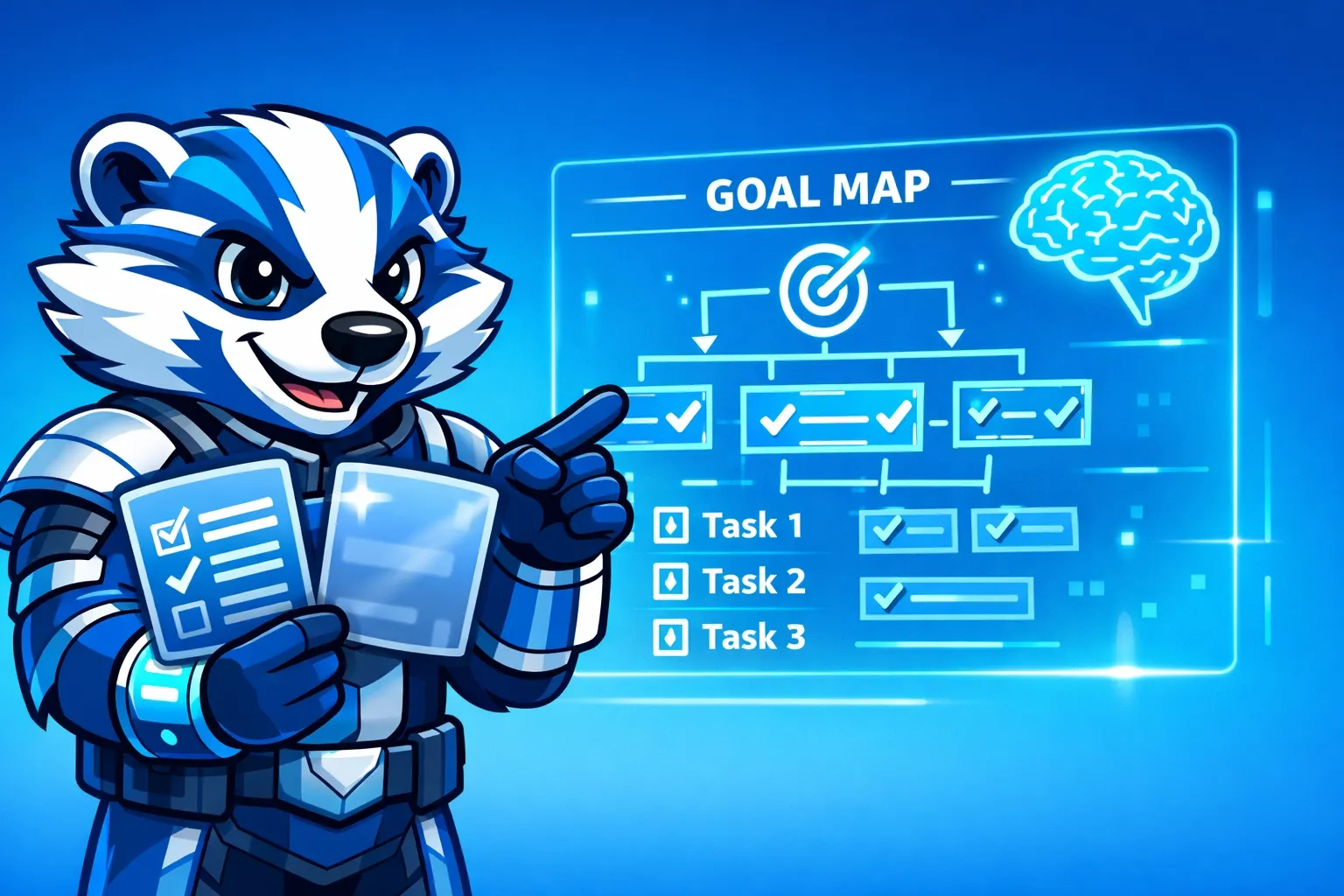
At Goalbadger, we don't believe in "to-do lists." To-do lists are just graveyards for good intentions. Instead, we use Goal Maps.
Think of a Goal Map as an externalized hard drive for your ambitions. Instead of waking up and asking, "What should I do today to be successful?" (a question that requires massive cognitive load), you simply look at your Map.
The Map knows where you are. It knows where you're going. And it knows the micro-action you need to take in the next twenty seconds.
By offloading the "memory" part of the goal to our AI-powered platform, you free up your brain to do what it’s actually good at: Execution.

Caption: A visual representation of a Goal Map vs. a cluttered To-Do List.
The Mascot in Your Corner
You’ve probably seen him around: our blue and white striped Goalbadger. He’s determined, he’s supportive, and he’s got a bit of a "no-nonsense" streak.
He isn't there to yell at you. He’s there to be your external executive function. When your brain enters "gist" mode and forgets why you're eating kale instead of pizza, the Goalbadger is there with a supportive nudge.
He represents the Goalbadger Circle: the idea that success is a recursive loop of planning, tracking, and smashing. He wears that high-tech gear because he knows that in 2026, raw willpower is "standard issue." To win, you need "special ops" tools.

Memory Self-Efficacy: The Secret Weapon
There’s a fascinating bit of research regarding memory self-efficacy. Essentially, if you believe you can remember your goals and track your progress, you are significantly more likely to actually do it.
But self-efficacy isn't built by positive affirmations in the mirror. It’s built by evidence.
Every time you check off a micro-action on your Goal Map, you aren't just "doing a task." You are providing your brain with a salient, episodic memory of success. You are proving to yourself that you are the kind of person who follows through.
This builds a "delayed memory effect." Over time, these distinct wins stack up, creating a narrative of competence that motivation alone could never sustain.
The Problem with Being a "Lone Wolf"
If memory is the internal problem, isolation is the external one.
When you’re the only person who knows about your goal, it’s incredibly easy to "forget" it when things get tough. We call this "strategic forgetting." If nobody saw you fail, did you really fail?
That’s why we built Clans.
In a Goalbadger Clan, your memory is distributed. Even if you have a "low executive function day," your Clan hasn't forgotten your goal. They provide the scaffolding: the Command and Control: that keeps you upright when your own internal pillars are feeling a bit shaky.
It’s a statistical guarantee: you are 95% more likely to achieve a goal when you have a specific accountability appointment with someone you’ve committed to. That’s not "fluffy advice." That’s hard data.

Stop Relying on Your Brain
Your brain is a magnificent tool for solving problems, creating art, and connecting with people. It is, however, a terrible filing cabinet for long-term aspirations.
If you are tired of the cycle of "Inspiration -> Hard Work -> Forgetting -> Shame," it’s time to change your strategy.
Stop trying to be more motivated. Start being more memorable to yourself.
Map it out. Use our AI to turn that "someday" into a Goal Map.
Micro-size it. If a task takes more than 20 seconds to initiate, it’s too big. Break it down.
Externalize it. Put the badger in your pocket. Let the app handle the reminders so your brain can handle the work.
Success isn't about being a superhero. It's about being a Goalbadger: someone who knows their weaknesses and builds a system that makes them irrelevant.
Ready to stop forgetting and start finishing?
Build your first Goal Map today.
Goalbadger, Inc. is an AI-first productivity platform designed for those who refuse to let their executive function define their potential. Whether you're navigating the ADHD brain or just a busy life, we provide the map. You provide the hustle.